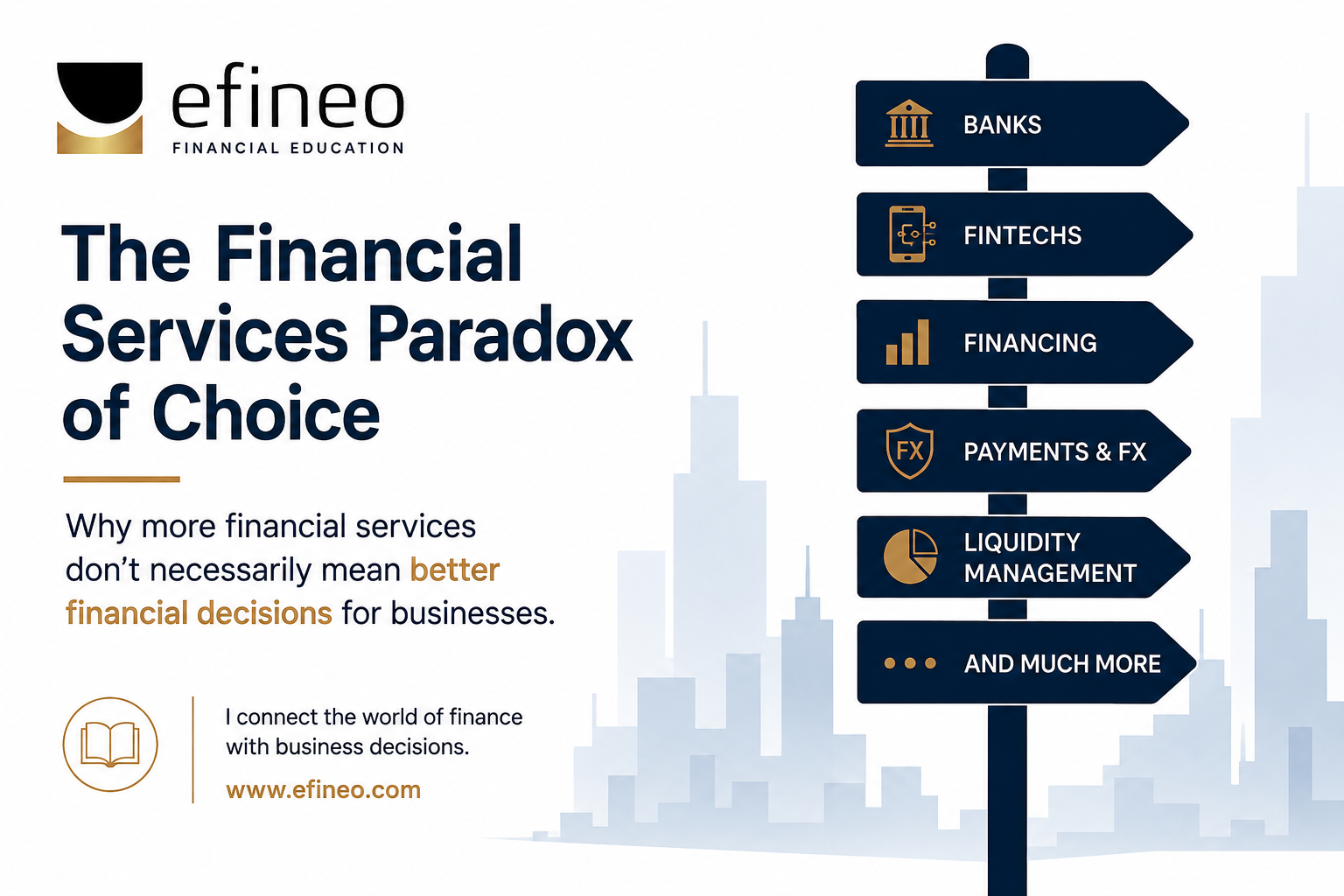
Why more financial services don’t necessarily mean better financial decisions for businesses
Thirty years ago, the financial world looked much simpler from the perspective of an entrepreneur. Most companies worked with one main bank, sometimes two. The bank provided the current account, financing, payments, foreign exchange and, for larger companies, treasury products or trade finance. There were of course insurers, leasing companies and other specialist institutions, but the centre of gravity was clear. For most businesses, finance meant banking.
That world has changed almost beyond recognition. I have had the opportunity to observe this transformation from several different perspectives over the last three decades: first from inside traditional banking, later from fintech, and more recently from conversations with entrepreneurs, CFOs, banks, technology companies and other financial providers. What strikes me today is not simply how much innovation has taken place, but how dramatically the structure of the market has changed.
The broad transformation began well before the word “fintech” became part of everyday business vocabulary. Internet banking, electronic payments, online dealing platforms and digital distribution had already started changing financial services in the 1990s and early 2000s. The real acceleration, however, came during the last fifteen to twenty years, particularly after the global financial crisis. Technology became cheaper, regulation opened parts of the financial market to new participants, customers became more comfortable buying financial services digitally and capital flowed into companies trying to improve individual parts of the traditional banking model.
The result was an extraordinary proliferation of new providers. Banks were joined by fintechs, neobanks, payment institutions, electronic money institutions, FX specialists, alternative lenders, digital factoring businesses, treasury platforms, insurtechs, wealthtechs, crypto companies, blockchain businesses and an increasing number of technology companies embedding financial services into their products.
This transformation becomes even more interesting when we look at the numbers. The European banking sector has actually been consolidating for years. In 2009 there were close to 8,000 credit institutions in the European Union. By 2024 the number had fallen below 5,000. Bank branch networks have contracted even more significantly, while assets have become increasingly concentrated in the largest institutions.
At the same time, the fintech ecosystem has moved in the opposite direction. Depending on the methodology used, there are now roughly 10,000 fintech companies operating across Europe. The United Kingdom alone accounts for several thousand, while Germany, France, Switzerland, Spain, the Netherlands and a number of smaller regulatory hubs have developed substantial fintech ecosystems of their own.
These figures obviously need to be treated carefully. A “credit institution” is a clearly defined regulatory category, while “fintech” is a much broader description. A fintech may be a licensed payment institution, a lender, a technology company, a broker, a software provider or, increasingly, a bank itself. Comparing the two numbers directly would therefore be misleading. But the direction of travel is unmistakable. Europe has fewer traditional banking institutions than it used to have, while the number of ways in which a business can access financial services has exploded. This has brought enormous benefits.
Competition has forced financial institutions to improve. Payments are faster. Foreign exchange is more transparent. Account opening has become easier. Smaller companies can access solutions that were once available mainly to large corporates. APIs and open banking make it possible to connect financial data from several institutions. Alternative lenders have created new sources of capital. Specialist FX providers have challenged traditional bank pricing and service models. Treasury technology that would once have required a large IT budget is increasingly accessible to mid-sized companies.
Fintech has also forced banks to move faster. Many features that we now take for granted in banking would probably have arrived much more slowly without competition from new entrants. For customers, this sounds like an unequivocally positive story. More competition, more innovation and more choice should logically lead to better financial decisions. I am no longer convinced that it always does as there is a second side to this transformation, and I think it receives much less attention. The financial market has become more accessible, but at the same time it has become considerably more difficult to navigate.
Imagine a CFO of a growing European company. The business needs additional working capital. The obvious option may still be a traditional bank facility, but it is no longer the only one. The CFO may also consider factoring, invoice financing, supply-chain finance, an alternative lender or a debt fund. Some of these solutions can complement one another; others may compete for the same collateral or affect existing banking covenants. The company also sells abroad and buys in several currencies. It therefore needs to decide not only where to exchange currencies, but whether to hedge its exposures and how. Should it continue using its bank? Add a specialist FX provider? Work with several counterparties? Use forwards, options or a combination of instruments? How should the company compare pricing when the true cost is not always visible in an explicit fee? Then there are payments. Local accounts, cross-border payments, SWIFT, SEPA, virtual IBANs, payment institutions and specialist international payment providers all offer slightly different combinations of cost, speed, coverage and operational convenience.
If the company has several entities and banking relationships, another set of questions appears. Should it introduce a treasury management system? Connect banks through APIs? Use an open-banking aggregator? Implement cash pooling? Centralise payments? Automate cash-flow forecasting? Each individual innovation may solve a genuine problem. Taken together, however, they create a new problem: somebody has to understand how all these pieces fit together. This is what I mean by the Financial Services Paradox of Choice.
The problem facing many businesses is no longer simply a lack of access to financial products. In many cases the opposite is true. There are so many providers and so many possible solutions that understanding the market has itself become a significant management challenge. And financial services are particularly difficult to compare. A loan is not simply an interest rate. The real value of a financing arrangement also depends on collateral, covenants, tenor, repayment structure, documentation, flexibility and the behaviour of the lender when circumstances change.
Foreign exchange is not simply a quoted spread. The quality of the service depends on execution, transparency, credit lines, hedging instruments, settlement infrastructure and the quality of risk-management advice. A payment provider may offer an attractive transaction fee but be less suitable because of settlement limits, geographic coverage, integration requirements or the regulatory model under which client funds are held.
Even technology that promises simplification can create complexity. Every new provider potentially means another contract, another integration, another source of data, another reconciliation process and another operational dependency. This becomes particularly important when we move away from large corporations.
A multinational company may have a dedicated treasury department with specialists in liquidity, funding, foreign exchange, interest-rate risk and banking infrastructure. A medium-sized company usually does not. The CFO may simultaneously be responsible for accounting, financing, taxation, budgeting, reporting, banks, insurance and operational matters. In a smaller company, many of those decisions are still made directly by the owner. Yet the financial ecosystem available to all of them is becoming increasingly sophisticated. There is another important dimension to this. Most financial providers naturally look at a company’s needs through the lens of their own business model. This is not a criticism; it is simply how markets work.
A bank sees opportunities through the products that a bank can provide. An FX specialist naturally focuses on currency management. A factoring company sees receivables as a potential source of liquidity. A payments fintech concentrates on payment flows. A treasury software company sees opportunities for automation and connectivity. Each may be completely right within its area of expertise, but the client still has to decide how the recommendations fit together.
That is why I believe one of the biggest gaps emerging in business finance is not another product category. It is the layer between the products and the decision maker.
We have become very good at producing financial solutions. We are less good at helping companies understand which combination of those solutions actually makes sense. This does not mean that banks are becoming irrelevant. Quite the opposite. Despite two decades of fintech disruption, banks remain the backbone of the European financial system. They provide the balance sheets, deposits, lending capacity, regulatory infrastructure and institutional stability that cannot simply be replaced by thousands of specialist startups. The more interesting development is that the border between banking and fintech is becoming increasingly difficult to define.
Banks use fintech technology. Fintech companies use banking infrastructure. Some fintechs obtain banking licences. Banks invest in fintechs or build their own digital platforms. Payment institutions partner with banks. Software companies embed payments, lending or treasury functionality directly into business applications.
The future therefore seems much less likely to be a simple competition between “banks” and “fintechs”. It is increasingly an ecosystem in which different institutions perform different roles.
For a business customer, the important question is not who wins that competition. No-one will… The important question is how to use that ecosystem intelligently. I’m sure we need to broaden the way we think about financial education for entrepreneurs and managers. Financial education is often understood as learning basic concepts: how interest works, what a forward contract is, how credit is priced or why liquidity matters. That remains useful, but it is no longer sufficient. Business financial education increasingly needs to explain the architecture of the market itself. Who provides which services? What is the difference between a bank, an electronic money institution and a payment institution? When does a specialist provider offer genuine value? When is it better to stay with the bank? When does using several providers improve the company’s position, and when does it simply add operational complexity? These are increasingly practical management questions rather than technical financial questions. After watching the financial industry innovate for many years, I am beginning to think that perhaps we already have enough financial products. Of course, innovation will continue and it should. But another app, another lending platform or another payment solution does not automatically make the financial system more useful to a company.
The next important step may be less spectacular. It may simply be helping businesses make better use of what already exists. That requires a shift in perspective. Instead of starting with the question, “Which financial product can we sell?”, we should perhaps start with a different one: “What is this business trying to achieve, what financial problems does it actually have, and which combination of solutions makes the most sense?” For me, this is the real consequence of thirty years of change in financial services.
We have succeeded in expanding access. We have created competition. We have broken apart many elements of the traditional banking model and rebuilt them in new ways. We have given businesses a degree of choice that would have been difficult to imagine a generation ago but the choice is not the same thing as capability.
A company can have relationships with five banks and still manage liquidity badly. It can have access to sophisticated hedging instruments and still have no sensible currency-risk policy. It can use several fintech platforms and still pay too much for financial services. It can collect enormous amounts of financial data and still struggle to turn that data into decisions.
The financial industry has spent the last two decades making more things possible. The next challenge is helping businesses understand which of those possibilities are actually worth using.
That is the Financial Services Paradox of Choice: we have never had more financial options, but the ability to choose well has never been more important.
Jakub Makurat

Copyright © 2026. Jakub Makurat. All rights reserved.